

At Glaucoma Consultants of Texas, we provide thorough and comprehensive management of glaucoma in order to achieve optimal preservation of your vision. We also strive to utilize the latest technology available to provide high quality care for our patients.
As part of your care, you will have some tests both initially and on an ongoing basis to help diagnose and manage your condition. The following will help you understand and prepare for the tests you will have performed.
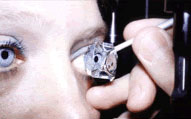 PURPOSE: A special mirrored contact lens is used to allow the doctor to examine the structures in the front of the eye. With this lens, the doctor can assess the eye’s drainage system in greater, more magnified detail which is important in diagnosing the type of glaucoma a patient may have.
WHAT TO EXPECT: An anesthetic eye drop, which burns slightly upon instillation but quickly resolves, will be used to numb your eye. The numbing effect of the drop usually lasts about 15 to 20 minutes. The doctor will gently place the mirrored lens on your eye, however, you will not feel pain. The only discomfort you may feel is a slight tickle near your eyelashes and some pressure. It is important to try not to move or blink. This test will only take about 1 minute per eye.
FREQUENCY: This test is performed on the initial visit and may occasionally be repeated on a follow up exam.
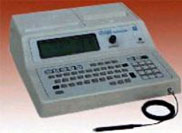 PURPOSE: The pachymeter is an instrument that measures the thickness of the cornea. Unusually thick or thin corneas can skew the measurements and give inaccurate pressure readings. For example, a thin cornea can make it seem as if your pressures are low when in fact they are at dangerous levels damaging the optic nerve. It was determined that in patients already at risk because of high eye pressure, those with the thinner corneas were three times as likely to develop glaucoma as those with thick corneas. Therefore, in order to get an accurate assessment of the true pressure in your eye, it is important to know the exact thickness of your cornea.
WHAT TO EXPECT: An anesthetic drop will be placed in your eye which burns slightly upon instillation but quickly resolves. The examiner will instruct you to look at a fixation point while an ultrasound probe is gently placed on your eye for a few seconds. You will not feel the probe due to the numbing effect of the drop, which lasts for approximately 15 to 20 minutes.
FREQUENCY: This test is usually performed on the initial visit.
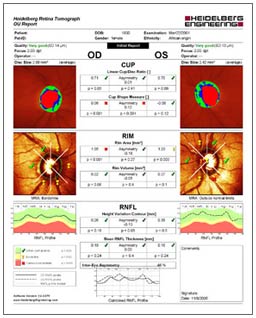 PURPOSE: This highly technologically advanced test allows for optic nerve imaging that scans the retinal surface and optic nerve with a laser. It then constructs a topographic (3-D) image of the optic nerve. It also measures the physical thickness of the nerve fibers in your retina. Since, in glaucoma, the nerve fibers are lost, patients with glaucoma are likely to have a thinner nerve fiber layer than normal. By measuring changes in the nerve fiber layer thickness over time, this test can detect small changes in glaucoma progression. Optimally, these changes will be spotted before there is progression in the visual field, which represents vision loss. This state-of-the art technology in glaucoma care is extremely helpful in the management and early detection of glaucoma. We have recently updated out software to the new HRT 3. Compared to previous versions of this test, the HRT 3 takes into account many helpful factors such as race. Among many other things, it also gives more detailed information about the appearance of the optic nerve, such as size.
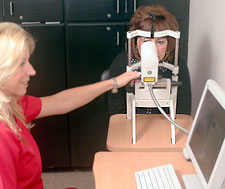 WHAT TO EXPECT: The examiner will instruct you to look at a green fixation light while the instrument automatically performs a scan of the optic nerve. It is important to refrain from blinking or moving during this test since better quality of images leads to more accurate results. This test usually takes approximately 15 seconds per eye.
FREQUENCY: This test is normally performed once a year, but may be used more frequently when needed since it is a valuable tool for spotting very subtle changes.
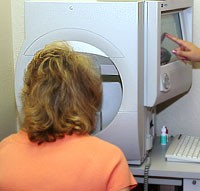 PURPOSE: The visual field gives the doctor important information about the neurological function of the retina, optic nerve, and the brain. It will be used to test and monitor peripheral vision which is where damage from glaucoma usually begins. Subtle peripheral vision deficits may only be detected by the sophisticated methodology of a computerized visual field analyzer. With the use of this computerized system, we will be able to detect any minor loss of peripheral vision over time and treat you accordingly in order to prevent progression. The visual field printout will be carefully interpreted by your doctor and you will be advised of your results on your next visit.
WHAT TO EXPECT: You will be asked sit in front of a concave dome and stare at a central target within the dome. A computer-driven program flashes small lights at different locations within the dome's surface, and you press a button when you see the small lights in your peripheral vision.The lights can be bright or dim at different stages of the test. Some of the flashes are purely to check you are concentrating. It is very important that you are alert and well rested for this test. One eye is tested at a time while the other one is patched. The test will last approximately 5 minutes per eye.
FREQUENCY: This test is repeated every 6 to12 months so your doctor can carefully monitor any progression of vision loss due to glaucoma.
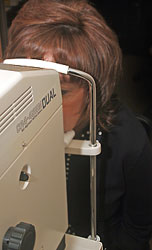 PURPOSE: Fundus photography is a highly specialized form of medical imaging that requires a customized camera mounted to a microscope with intricate lenses and mirrors. These high-powered lenses are designed to be able to photograph the appearance and health of the optic nerve. The doctor assesses your optic nerve on every visit and documents changes. However, having actual photographs of the nerve allows even better documentation. Comparing optic nerve photographs taken over the course of several years is without question a very effective method to follow and detect glaucoma progression.
WHAT TO EXPECT: You will be asked to stare at a fixation device so the eyes are still. While the examiner is taking the pictures, you will see a series of bright flashes. The entire process usually takes approximately five to ten minutes. Occasionally, it may be necessary to dilate your eyes in order to obtain an acceptable image.
FREQUENCY: These photographs are taken once a year to document and to monitor any progression of damage to the optic nerve. More frequent photographs may be taken if the doctors detect any changes on an interim visit.
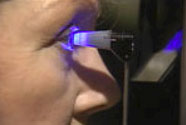 PURPOSE: The intraocular pressure is measured with a special instrument called a tonometer. Damage to the optic nerve can occur if the pressure within your eye is too high for your optic nerve to withstand. Your doctor will determine what pressure is best for you. This target pressure is carefully determined by your doctor based on many different factors and is usually different for each individual. Furthermore, the pressure in your eye is subject to cyclic fluctuations through the day. There is therefore a chance of missing a pressure elevation with single readings. Your doctor may ask you to return at a different time of day to have a better idea of your pressure cycle and to detect fluctuations in your pressure that may be outside normal limits.
WHAT TO EXPECT: Anesthetic eye drops which sting slightly with a yellow dye will be placed in your eye prior to the test. The effects of this drop will only last 15-20 minutes. The examiner will instruct you where to look while a probe illuminated by a blue light approaches your eye. You may feel the probe on your eyelashes but you will not feel any pain. It is important to continue looking where instructed without blinking or moving. Try to relax as much as possible and breathe normally during this test as this can affect the pressure reading. It is also important to loosen any tight clothing around the neck, such as a neck tie, as this can give false readings.
FREQUENCY: Since abnormal pressures usually do not cause symptoms, it is very important to have the pressure checked regularly. The pressure will be measured periodically, usually every 3 to 4 months to make certain your glaucoma is well controlled and there is no further damage to your optic nerve. It may be necessary to monitor it more frequently if your doctor feels it to be necessary. Just as it is important for blood pressure and blood sugar to be monitored for patients with hypertension and diabetes, it is important for you to have your eye pressure measured regularly.
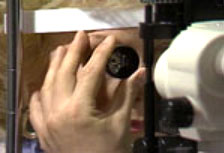 PURPOSE: With the use of a magnifying lens and a bright light source the doctor is able to physically see areas in the back of your eye such as the retina, macula, and optic nerve. Ophthalmoscopy is not only used to detect diseases specific to the eye, but it can also detect changes in the eyes due to certain diseases affecting other parts of the body. For instance, it is used to detect the changes that occur in the retinal blood vessels in people who have high blood pressure and diabetes mellitus. Since the optic nerve is the main area of damage in glaucoma, your doctor will evaluate it on every visit. It is usually possible to view the optic nerve alone without dilating your eyes. However, it is also important to dilate your eyes in order to thoroughly check the entire back of your eye for numerous types of eye diseases.
WHAT TO EXPECT: In order to dilate your eyes, eye drops are used to widen (dilate) your pupils. This makes it easier to see the back of the eye. The eye drops take about 15 to 20 minutes to dilate the pupil fully. When the doctor is evaluating your eyes, you may feel discomfort from the brightness of the light. It is normal to see shadows for a few minutes after the doctor is finished examining you. Be aware that you will be light sensitive, and it may be necessary to wear sunglasses when you go outside or into a brightly lit room. You may also have trouble focusing your eyes, especially when looking at things up close. For these reasons, you may wish to arrange to have someone drive you home after the test. The effects of the drops usually last for several hours.
FREQUENCY: In order to dilate your eyes, eye drops are used to widen (dilate) your pupils. This makes it easier to see the back of the eye. The eye drops take about 15 to 20 minutes to dilate the pupil fully. When the doctor is evaluating your eyes, you may feel discomfort from the brightness of the light. It is normal to see shadows for a few minutes after the doctor is finished examining you. Be aware that you will be light sensitive, and it may be necessary to wear sunglasses when you go outside or into a brightly lit room. You may also have trouble focusing your eyes, especially when looking at things up close. For these reasons, you may wish to arrange to have someone drive you home after the test. The effects of the drops usually last for several hours.
