

Glaucoma surgery is usually recommended when treatment with eye drops and laser eye surgery cannot lower the intraocular pressure to a safe level. The most widely performed type of glaucoma surgery is a trabeculectomy, also known as “filtering surgery”. In this procedure a new drainage canal, or filter, is surgically created for the eye. The internal eye fluid drains through the filtering site, or window, and collects into a tissue pocket underneath the upper eyelid. The fluid filled reservoir is called a bleb. The fluid is then absorbed into tiny blood vessels and returned into the body’s circulation.
About the Surgery
In performing a trabeculectomy your doctor will remove a small piece of tissue from the eye usually in the area covered by the upper eyelid. This opening, or window, allows fluid to pass more freely out of the eye. A small flap of tissue covers the opening and is sutured into place. This acts as a trapdoor. It can be adjusted to allow more or less fluid to pass through the opening. The doctor adjusts the amount of flow by cutting the stitches postoperatively. When the fluid drains out of the eye, it flows into a tissue pocket reservoir underneath the upper eyelid. This is created by the surgeon at the time of the surgery.
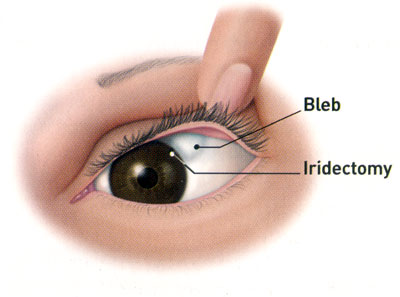
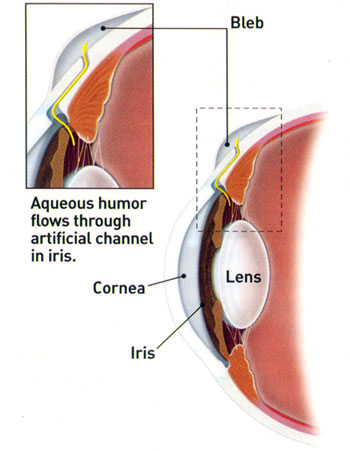
Trabeculectomy is generally performed in an outpatient setting, which means you can return home later in the day after the surgery. Local anesthesia is used to help keep your eye comfortable and still throughout the surgery. Sedation may also be given to help you stay relaxed. There is an eye patch and shield over the operated eye at the time of discharge, and this needs to stay on through the first night after surgery. Follow your doctor’s orders about removing these protective materials the following day.
After the Surgery
Your eye will be examined in the office by your doctor the day after the surgery. A group of eye medicines will be prescribed depending on the findings at the time of the examination. In most cases postoperative medication will include an antibiotic to help prevent infection, a steroid, to help with the healing process, and a dilating drop, to help stabilize the eye internally. The pressure in the eye usually fluctuates quite a bit postoperatively. If it is initially somewhat high, there may be pressure-lowering medicine used as well. It is important to use these medicines as directed since this can make a great deal of difference in the success of the procedure. There are a number of activity restrictions needed during the first several weeks after the surgery. Your doctor will go over the specific requirements but, in general, it is important to refrain from lifting, bending, and straining. Keeping your “head above your heart” is a good rule-of-thumb to use. Protective eye wear is required at all times. This means wearing your glasses during the day, and your eye shield (taped securely in place) during the night. There may also be some specific instructions regarding your sleeping position. Hair washing requires great care so as to avoid inadvertent injury to the healing eye. Your doctor will go over his or her instructions outlining the preferred modifications recommended for you. Again, it is very important to follow the directions carefully so as to give your eye surgery the best possible opportunity for success.
Patients are typically seen frequently during the first several weeks postoperatively so that any change in the eye condition can be spotted in the early stages. The vision fluctuates daily and is usually blurred for at least the first several weeks and often even longer. Intraocular pressure will change, often dramatically, also. There may be benefit from cutting a stitch to open the scleral flap trapdoor to lower the pressure. This can be done at the laser in the doctor’s office. In general, as the healing period progresses, the intraocular pressure will settle down and stabilize. Your doctor will adjust your medicines and activity level accordingly throughout your recovery.
Long Term Success
The natural healing process plays an important role in the long-term success of trabeculectomy. Every person heals a little differently. The response of the body to an injury is to form a scar at the site of the wound. This process occurs after trabeculectomy surgery also, and this allows the eye to heal and the pressure and the vision to become stabilized. However, if the healing response is strong, too much scar tissue can form. In some cases it can grow over the window and close down the filter. If this occurs the eye pressure will again begin to climb. It may be necessary to restart eye drops or pills. Sometimes even another surgery is needed to help return the eye pressure to a lower level.
There are a variety of complications which may occur in the course of the trabeculectomy surgery and the recovery period. You should discuss any specific questions you have about this with your doctor. As a general rule trabecelectomy surgery has a 70 to 80% success rate depending on numerous factors. 10-20% of eyes will be able to achieve satisfactory pressure control if eye drops are added. This means that 90% of patients will have satisfactory pressure lowering after trabeculectomy.
