
 Glaucoma is a very misunderstood disease. Often people do not realize the severity of it or who is affected. It is one of the leading causes of blindness. It is estimated to affect one of every 50 adults. Although glaucoma can occur at any age, the risk of developing the disease increases dramatically after the age of 35. Glaucoma is more likely to develop in persons who have a family history of the condition and is more common in diabetics and African Americans.
Vision loss from glaucoma is permanent but can usually be prevented with early detection and treatment. Because the symptoms of early glaucoma are so slight, the disease often goes unnoticed until permanent vision loss has occurred.
Glaucoma is a disease caused by increased intraocular pressure (lOP) resulting either from a malformation or malfunction of the eye's drainage structures. Left, untreated, an elevated lOP causes irreversible damage to the optic nerve and retinal fibers resulting in a progressive, permanent loss of vision. When glaucoma damages your optic nerve, you begin to lose patches of vision, usually side vision (peripheral vision). Over time, glaucoma may also damage straight ahead (central) vision. You may not notice a loss of side vision until you have lost a great deal of your sight.
A clear liquid called aqueous humor circulates inside the front portion of the eye. To maintain a healthy level of pressure within the eye, a small amount of this fluid is produced constantly while an equal amount flows out of the eye through a microscopic drainage system. This liquid is not part of the tears on the outer surface of the eye.
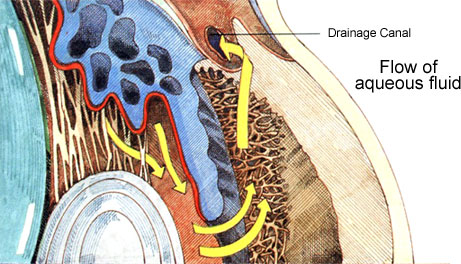
Because the eye is a closed structure, if the drainage area for the aqueous humor — called the drainage angle — is blocked, the excess fluid cannot flow out of the eye. A build up of fluid within the eye causes the eye pressure to increase, damaging the optic nerve.
However, early detection and treatment can slow, or even halt the progression of the disease. Glaucoma is often called "the sneak thief of sight." That's because people usually do not notice any signs of the disease until they have already lost significant vision. Once lost, vision can't be restored. More than 2.2 million Americans over the age of 40 have open angle glaucoma, the most common form of glaucoma. At least half don't even know they have it.
Other factors besides intraocular pressure appear to contribute to glaucoma. Some people with normal pressure may experience vision loss from glaucoma, and many people with high lOP (sometimes called ocular hypertension) do not develop glaucoma. However, the higher the lOP, the more likely optic nerve damage will occur.
 Glaucoma is a very misunderstood disease. Often, people don't realize the severity or who is affected. Glaucoma can cause blindness if it is left untreated. Worldwide, there are an estimated 65 million cases of glaucoma. There are approximately 3 million cases in the United States, but only one-half of those have been diagnosed. About 2% of people between the ages of 40 and 50, and 8% of those over 70, have elevated intraocular pressure in one or both eyes.
There are 120,000 people in the United States who are blind as a result of glaucoma, which accounts for 9-12% of all cases of blindness. It is the second leading cause of permanent vision loss and the leading cause of preventable blindness. Open angle glaucoma accounts for 19% of blindness in African Americans and 6% in Caucasians. Glaucoma is 6 to 8 times more common in African Americans than Caucasians, and they are more likely to become blind from it.
Asians and Eskimos have a higher prevalence of primary angle-closure glaucoma than other ethnic and racial groups. Normal-tension glaucoma is more prevalent in people of Japanese ancestry and in those with a history of systemic heart disease. This type is also more common in women, the elderly, and people with myopia. Family history of this disorder also increases the risk.
A Research To Prevent Blindness Survey found that:
The economic impact of Glaucoma accounts for over 7 million visits to physicians each year. In terms of Social Security benefits, lost income tax revenues, and health care expenditures, the cost to the U. S. government is estimated to be over $1.5 billion annually.
